

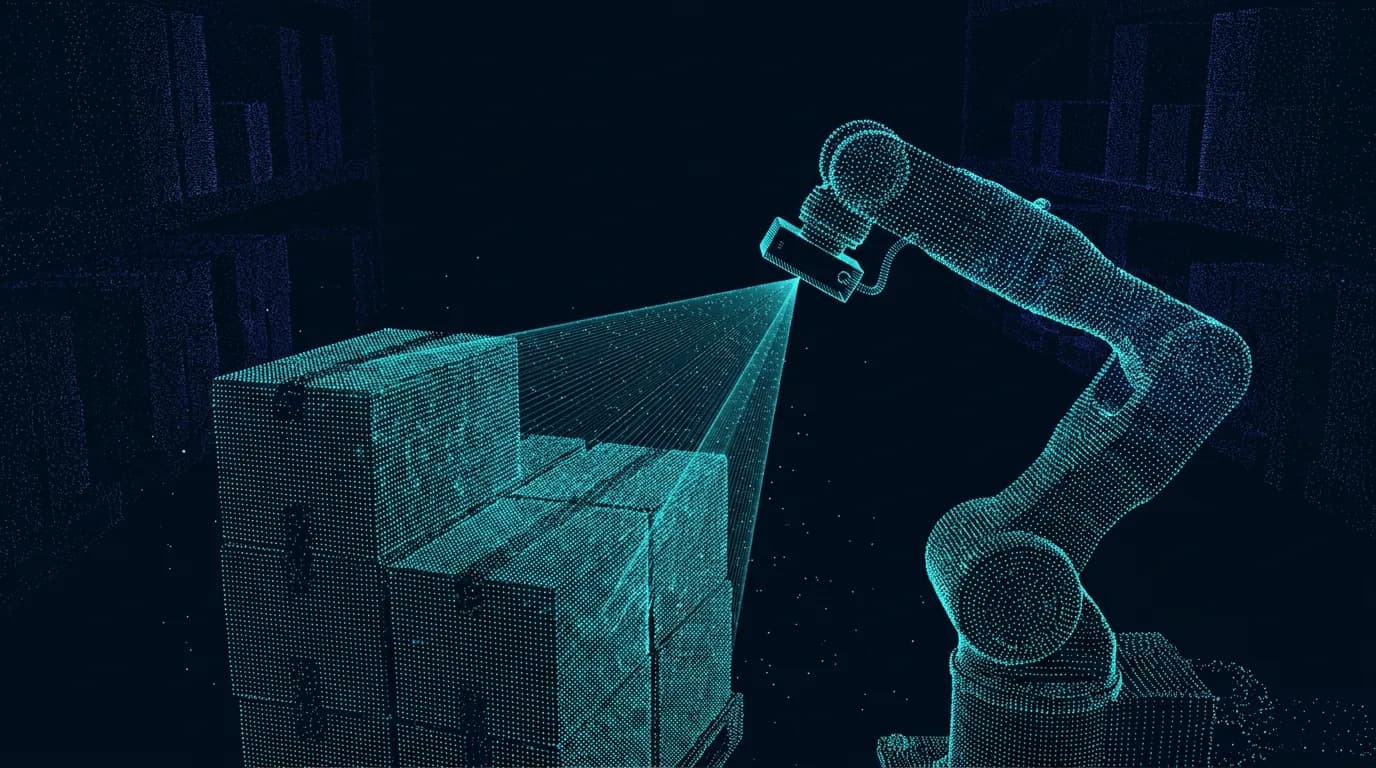
Imagine a robot that can not only see, but truly understand the world around it — navigating crowded warehouses, picking fragile objects with precision, identifying objects in 3D space, or responding safely to human movement. This is the power of depth sensing cameras, a key perception technology transforming ordinary robots into smarter, more aware machines.
By capturing detailed 3D information about the surrounding environment, depth sensing cameras give robots the spatial awareness they need to make real-time decisions, avoid obstacles, locate objects, and operate safely alongside people.
MorpheusTEK provides depth sensing camera and LiDAR solutions for robotics, automation, and industrial perception applications. These technologies help robotic systems better understand their environment and perform more safely, accurately, and efficiently.
What are depth sensing cameras?
Depth sensing cameras allow machines to measure distance, not just capture flat 2D images. Traditional cameras show what something looks like. Depth sensing cameras help determine where that object is in 3D space.
This is especially important in robotics because robots need to know:
- How far away an object is
- Where obstacles are located
- How large an object is
- Whether a path is clear
- Where to place a robotic arm or end effector
- How people or objects are moving nearby
This 3D awareness allows robots to move, react, inspect, pick, and navigate with greater intelligence.
Core technologies powering depth sensing cameras
Depth sensing cameras rely on several advanced technologies to capture accurate three-dimensional information. Understanding these core methods helps explain how robots perceive depth.
Time-of-Flight cameras
Time-of-Flight, or ToF, cameras emit infrared light and measure how long it takes for that light to reflect back from objects. This timing information is used to calculate distance and create real-time depth maps. ToF systems generally fall into two categories:
- Direct Time-of-Flight (dToF) measures the actual travel time of emitted light pulses.
- Indirect Time-of-Flight (iToF) estimates distance based on phase shifts in the returning light signal.
ToF cameras are valuable in robotics because they can provide fast, direct depth data with compact form factors. They are often used for obstacle avoidance, object detection, bin picking, pallet detection, close-range navigation, and human-machine interaction.
However, ToF sensors can be challenged by highly reflective materials, dark surfaces, strong sunlight, or other infrared interference depending on the application and sensor design.
Structured light cameras
Structured light cameras project a known infrared pattern — such as dots, grids, or lines — onto the environment. A camera observes how the pattern deforms across surfaces and uses that deformation to calculate depth.
Structured light can provide high-resolution depth information, especially at close range. It is often useful for gesture recognition, small object scanning, robotic inspection, and controlled indoor environments. Because structured light relies on projected patterns, however, it is typically less effective outdoors or in environments with strong sunlight.
Stereo vision systems
Stereo vision uses two or more cameras positioned a fixed distance apart to mimic human binocular vision. By comparing the difference, or disparity, between the images captured by each camera, the system calculates depth.
Stereo depth cameras can perform well outdoors and across longer ranges, especially when the scene has texture, contrast, and good lighting. They are useful for:
- Mobile robots
- Outdoor autonomy
- Drones
- Agricultural robots
- Industrial inspection
- Navigation in textured environments
Their performance can be reduced in low-texture environments, repetitive patterns, low light, or scenes with limited visual detail. Stereo systems also require more computational processing than some active depth sensing technologies.
Passive monocular depth techniques
Emerging approaches use a single camera, specialized optics, or AI-based models to estimate depth without active illumination. These systems can reduce size, power consumption, and cost, which is attractive for compact or battery-powered robots.
While passive monocular depth sensing continues to improve, it is often best used as part of a broader perception stack rather than as the only source of depth information in safety-critical or precision robotic applications.
Stereo vs. ToF: which depth sensing camera is best?
When selecting a depth sensing camera for robotics, it is important to understand the differences between stereo vision and Time-of-Flight technologies. Each has strengths and trade-offs that depend on the environment, range requirements, object types, lighting conditions, and processing constraints.
Stereo vision cameras at a glance
- Working principle
- Two or more cameras compute depth from image disparity
- Performance in sunlight
- Often better suited for outdoor use
- Depth accuracy
- Good — depends on texture, contrast, and lighting
- Range
- Longer ranges possible depending on optics and processing
- Computational load
- Higher, due to disparity calculation
- Power consumption
- Often lower — passive sensing
- Best fit
- Outdoor robots · textured environments · larger scenes
- Integration
- May require more calibration and processing
Time-of-Flight cameras at a glance
- Working principle
- Emits infrared light, measures return timing or phase shift
- Performance in sunlight
- Can be affected by strong sun or reflective surfaces
- Depth accuracy
- Strong close-range performance, even in low-texture scenes
- Range
- Often optimized for short- to mid-range sensing
- Computational load
- Lower — depth is measured more directly
- Power consumption
- Higher, due to active illumination
- Best fit
- Indoor robots · dynamic scenes · close range · low light
- Integration
- Compact and often easier to integrate
When to use stereo vs. ToF
- Outdoor autonomous robots may prefer stereo vision or LiDAR because of longer-range performance and better operation under natural lighting.
- Indoor robots and fast-moving systems often benefit from ToF cameras because they provide fast, direct depth sensing and compact integration.
- Robots requiring highly reliable navigation may combine depth cameras with 2D or 3D LiDAR to improve obstacle detection, localization, and mapping.
Depth sensing cameras give robots the ability to understand the world in three dimensions. Instead of simply capturing images, they help machines measure distance, interpret object position, and respond to their surroundings in real time. Whether using ToF, stereo vision, structured light, or RGB-D technology, depth sensing cameras are becoming essential to modern robotic perception.