

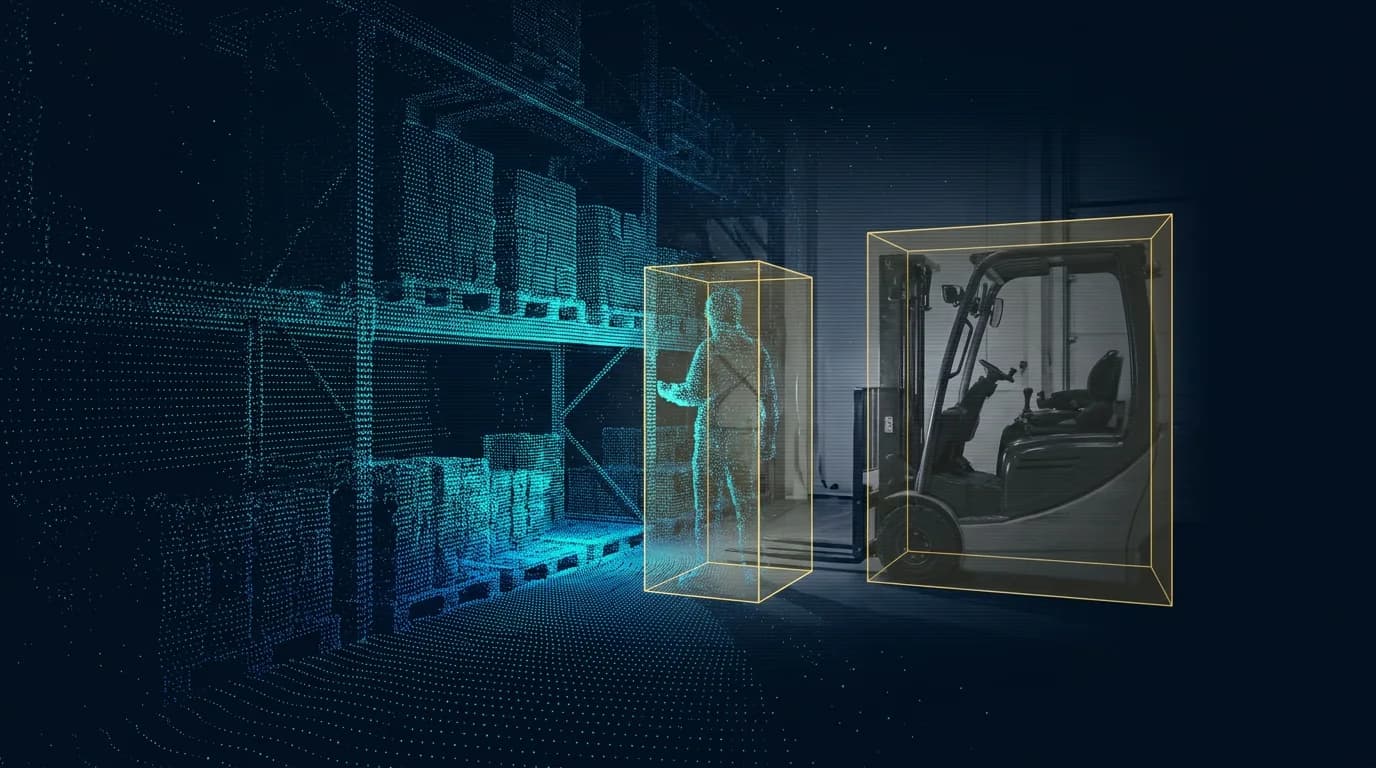
The smartest robots do more than detect distance. They combine 3D sensing, visual data, AI models, and real-time decision-making to understand what is happening around them.
Depth sensing cameras provide 3D spatial information. RGB cameras add color and visual detail. LiDAR adds accurate range measurement and geometric mapping. AI helps interpret the scene and decide what the robot should do next.
MorpheusTEK provides camera and LiDAR solutions that help robotic systems improve perception, automation, mapping, navigation, inspection, and object interaction.
Key robotics applications powered by depth sensing cameras
Depth sensing cameras are becoming fundamental to modern robotics. By providing accurate 3D data, they enable robots to operate more intelligently and efficiently across a wide range of industries.
Object detection and manipulation
In industrial automation and logistics, robots need to detect, identify, and manipulate objects of different shapes, sizes, colors, and materials. Depth sensing cameras provide spatial information that helps robotic arms understand where an object is located in 3D space. Applications include:
- Bin picking
- Parcel handling
- Robotic sorting
- Palletizing and depalletizing
- End-effector guidance
- Part inspection
- Pick-and-place automation
A depth camera mounted near a robotic end effector can help locate parts at close range, while a fixed overhead depth camera can help identify object position inside a bin or tote. In some systems, LiDAR can be used to detect larger objects or map the surrounding work area, while the depth camera handles close-range precision tasks.
Human-robot interaction and safety awareness
For robots working near people, spatial awareness is critical. Depth sensing cameras can help robots detect human presence, estimate distance, recognize gestures, and support safer interaction. Depth data can be used to help identify:
- A hand or arm near a collaborative robot
- Human posture or movement
- Gesture-based commands
- Proximity to moving equipment
Autonomous decision-making
Smarter robots use depth data to feed AI algorithms, SLAM systems, path planners, and object recognition models. By integrating 3D spatial information, robots can make better autonomous decisions in real time. Examples include:
- Selecting the best path through a crowded warehouse
- Avoiding unknown obstacles
- Identifying whether a pallet is present
- Detecting if a bin is full or empty
- Recognizing a human gesture
- Adjusting a robotic grasp based on object position
- Navigating uneven terrain outdoors
LiDAR can strengthen these decisions by adding accurate geometric distance data, especially at longer ranges or in low-light conditions.
How depth sensing cameras integrate with computer vision and AI
Depth sensing cameras play a vital role in advancing robotic intelligence by providing 3D data that complements traditional computer vision and artificial intelligence.
RGB-D data fusion
Many depth sensing cameras combine RGB color data with depth data — often called RGB-D sensing. RGB data helps the robot understand what something is. Depth data helps the robot understand where it is. Together, RGB-D data can improve:
- Object detection and classification
- Scene segmentation
- Robotic picking
- Measurement and inspection
- Human detection
- Navigation
For example, a robot may use RGB data to identify a package label or object type, while using depth data to determine its distance, size, and orientation.
Camera-LiDAR fusion for better perception
In advanced robotics, combining depth cameras with LiDAR can create a more complete perception system. LiDAR provides accurate range, strong mapping, longer-range obstacle detection, and reliable geometric structure. Depth cameras provide close-range 3D detail, RGB color information, object shape, and valuable data for computer vision and AI models. A common robotics architecture may use:
- 2D LiDAR for navigation and safety-zone awareness
- 3D LiDAR for mapping, outdoor autonomy, or large object detection
- RGB-D cameras for close-range object detection and manipulation
- AI software for classification, segmentation, tracking, and decision-making
- Edge computing for real-time onboard processing
This type of sensor fusion helps robots make better decisions in complex environments.
AI-driven activity and gesture recognition
Depth sensing cameras allow robots to capture spatial cues that are useful for human activity and gesture recognition. AI and machine learning models can use depth data to interpret body position, hand movement, posture, or motion patterns. This is valuable for:
- Human-robot collaboration
- Healthcare monitoring
- Service robots
- Gesture-controlled machines
- Retail automation
- Security and monitoring
- Smart industrial workcells
Depth data helps reduce ambiguity compared with 2D images alone because the robot can understand distance and body position in three-dimensional space.
Real-time decision-making and edge computing
Robotic systems often need to make decisions immediately, without waiting for cloud processing. Depth sensing cameras, LiDAR, and AI models can be integrated with edge computing hardware to process perception data directly on the robot. This supports:
- Faster response times
- Reduced network dependency
- Improved autonomy
- Local obstacle avoidance
- Real-time inspection
- Onboard AI inference
- Safer robotic behavior
MorpheusTEK supports robotics perception solutions that may include depth sensing cameras, LiDAR, and edge computing components depending on the application requirements.
Choosing the right depth sensing and LiDAR solution
The best solution depends on your robot, environment, and application requirements.
Close-range manipulation
A compact RGB-D camera or ToF depth camera may be the best fit for locating parts and guiding end effectors.
AMR and AGV navigation
A combination of depth cameras and 2D LiDAR may improve obstacle detection, mapping, and route planning.
Autonomous forklifts
Depth cameras assist with pallet detection and load handling, while LiDAR supports navigation and safety fields.
Outdoor and heavy industry
Agriculture, mining, ports, and construction may require stereo cameras, ruggedized depth cameras, 3D LiDAR, radar, and IMUs for range, sunlight, weather, vibration, and terrain.
Safety-rated protection
A certified safety LiDAR or safety scanner should be evaluated separately from standard perception cameras.
Advanced autonomy
Sensor fusion may combine RGB cameras, depth cameras, LiDAR, radar, IMUs, and AI software into one coordinated perception system.
Depth sensing cameras are essential for building smarter, more capable robots that can navigate, interact, inspect, and adapt with greater precision. LiDAR adds another powerful layer of perception with accurate range measurement, 2D or 3D mapping, obstacle detection, and safety-zone capabilities.
Whether your application requires RGB-D sensing, ToF depth cameras, stereo vision, 2D LiDAR, 3D LiDAR, safety LiDAR, or a complete sensor fusion approach, MorpheusTEK can help identify the right technology for your robotic platform — and empower your robots with stronger perception, better spatial awareness, and smarter autonomy.